Eleventh in a series on the edges of science
Somewhat surprisingly to me, my experience of scientists (and engineers) is that we tend to be a rather arrogant crowd. We know a lot. Worse than that, we know that we know a lot. We have a tendency to look down our noses at those “civilians” who don’t know so much.
This can be a dangerous attitude for those who seek Truth.
What’s really surprising about it is the consideration of how objectively little we really know. As much as we have plumbed the Universe and how it works, so many basic things escape us as to be astonishing. The theory of evolution is considered these days to be a solid piece of Truth, yet there are gaping holes in the geological record about which we know nothing. Modern medicine heals diseases that led only to death a few short years ago, but we can’t explain where cognition comes from. Or embryonic development by cell differentiation. We reach for the stars and far galaxies with our instruments and create theories about them without knowing what dark matter and dark energy (75% of the stuff of the Universe) might be.
Yes, we tend to be truly arrogant about what we know.
In a news article from two weeks ago, the oldest known shipwreck has just changed from 2200 years ago to 3300 years ago. The prior record from 1975 was held by a wreck in about 100 foot depth off the coast of the Greek island Dokos (ancient name Aperopia). The artifacts put this wreck into the Proto-Helladic period in which the Greek mainland was largely agricultural, but with early bronze-age metallurgy for tools and weapons. The wreck was largely dated by the existence of over 500 clay vases, ceramic and pottery pieces in styles known for that period.
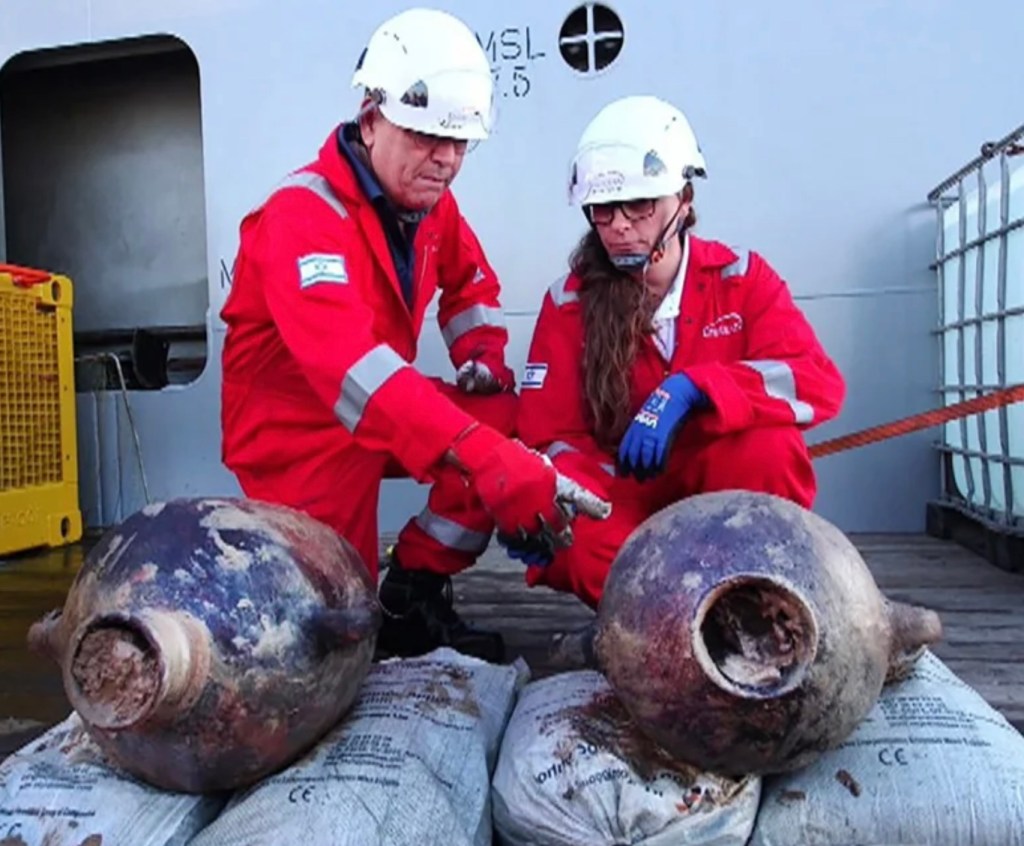
The new wreck was found this year 60 miles off the coast of Israel during an environmental survey by a gas production company. It lies in waters over a mile deep. Again, hundreds of intact jars were discovered on board, of the amphora type used to carry commercial goods—oil, wine, or agricultural products. (picture: Emil Eljam/Israel Antiquities Authority)
The leader of the environmental survey group characterized this as a “truly sensational find,” which it may indeed be, then continued to say “The discovery of this boat now changes our entire understanding of ancient mariner abilities.”
What a second. Run that one by me again.
That “entire understanding” would be the scientific Truth that mariners of that time flitted from port to port, never leaving sight of the coast. A well-established piece of knowledge, right? (But where did it come from?)
And the single discovery of one boat tells us exactly what about ancient mariner abilities?
It seems to me that both of these factors show evidence of arrogance: first, that we know what mariners did three thousand years ago, and second, that one discovery changes that knowledge.
The rather quick theory is that, since the wreck is 60 miles off the coast, therefore ancient mariners could be expected to sail out of sight of land. One ship in that location says that other ships must also have done this. This implies they must have had some form of celestial navigation, right? Or at least intimate knowledge of cross-Mediterranean currents and dead reckoning?
This is an excellent example of how preconceptions can cause even reputable scientists to jump to unwarranted conclusions. This wreck doesn’t fit the pattern, so therefore the pattern must be wrong. Let’s change our basic assumptions. Couple this with the academic imperative to publish (first) or perish, and coordinate it with the news media desire for sensationalism, and established scientific Truth becomes outdated, replaced by new established scientific Truth.
The articles reported by CNN, CBS, and other media also contain some clues that might call into question this leap of logic. The ship shows evidence of having sunk under distress. Perhaps violent weather. Or perhaps pirates, they say. (So, does that mean the pirates also sail out of sight of land? To intercept the luckless merchantman who tries to cut across a bight?) Of course, either of these events could have forced such a ship beyond its normal comfort zone. An immediate assumption that the mariners intended to be 60 miles off the coast might not be fully warranted.
These attitudes are not new. They play out in scientific discussion all around us. One of the major purposes of scientific journals is to allow the dissemination and review of new theories by other scientists. Often, the letters and short articles in those journals carry heated arguments and counter-arguments about conclusions exactly like this “change of our entire understanding.”
Treading the Truth and extending it into the future of science is a challenging thing to do. I thoroughly enjoy that challenge as I look to the future and try to envision what it might be. Scientific Truth definitely changes over time—but humanity does not.
Doc Honour
July 2024
 Doc Honour Books