
Fourth in a series on Civilization
When I envision a future world in my science fiction, of course I draw upon our current world. People don’t change, and haven’t in recorded history. We love, we fight, we work to feed and support ourselves and our families. Technology provides new opportunities that might change the way people work and interact, but the basics of humanity are the same.


This morning, I read an essay titled “Insights from a 1949 Guide for Housewives,” written by a modern woman who seemed surprised to find much good in such a book. She wondered “How much do I—an unmarried 25-year-old woman with a full-time job—have in common with a 1950s housewife?” The technologies have certainly changed. As the writer says, “Most of us can ignore the details about maintaining a wood-burning fireplace.” Yet the original author’s writing about the essence of homemaking was a key insight to the writer. She discovered that the author viewed homemaking as a full-time job of worth to the family and society.
When civilization works, each person in the society contributes something of worth to that society. It takes all of us to make a civilization.
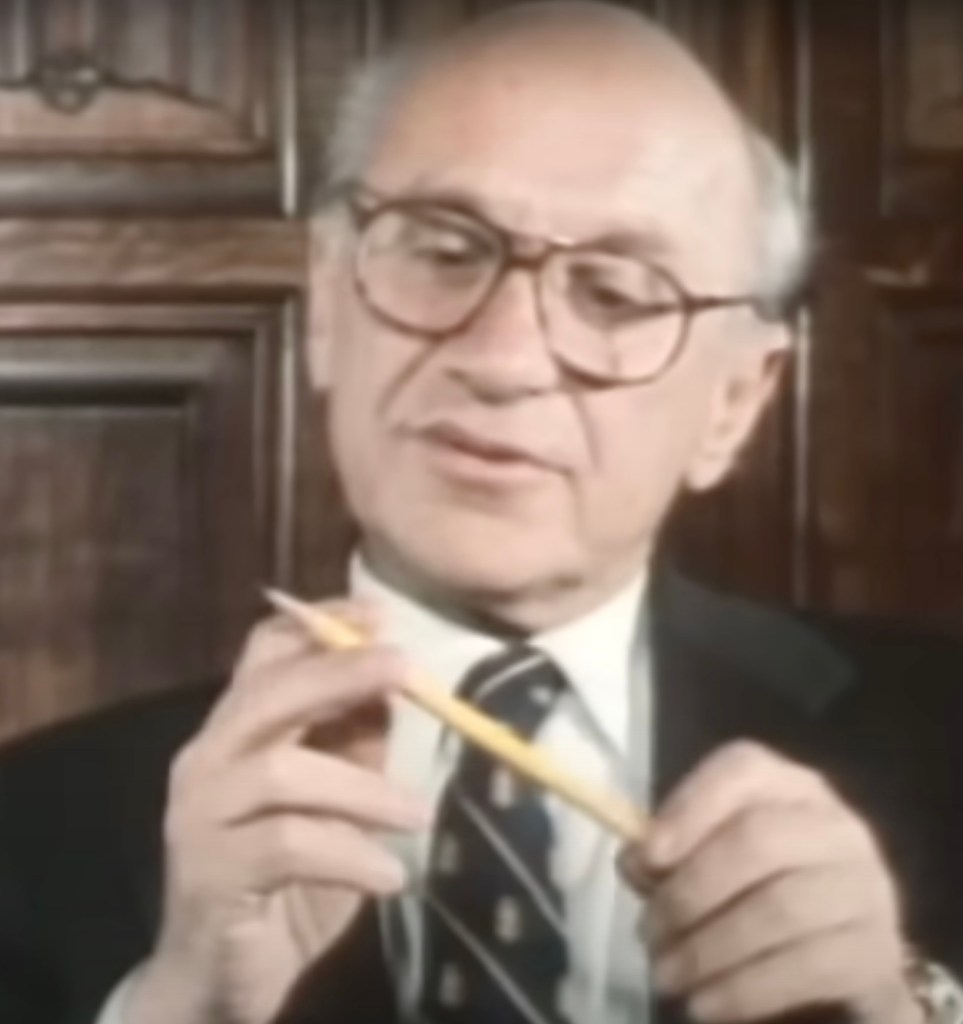
The economist Milton Friedman recorded a talk in which he held up a simple yellow pencil and noted, “There is not a single person in the world who can make this pencil.” The statement seems astonishing. A pencil is such a simple object. Surely any competent person would be able to craft such a thing. (see the full video here)
But Friedman goes on to point out the materials and infrastructure necessary to making the pencil. The wood may come from Oregon, the graphite from South America, the rubber eraser from Southeast Asia, and the metal ferrule from who-knows-where. Even the yellow paint has to be manufactured somewhere. Even more, Friedman points out the tooling necessary to mine the graphite and harvest the wood, which may be sophisticated metal equipment backed by gasoline, electricity, and a steel industry. By the time he considers everything, the supply chain for that simple pencil stretches around the world and into many businesses seemingly remote from it.
As I have written in my prior essays, the essence of civilization is twofold: specialization and cooperation. Each of us specializes our skills so as to provide value to others. Then each of us cooperates with others so those skills may mesh.
We do this without thinking much about it, without a grander purpose, and yet it happens.
Each of us wants to feed ourselves and our families. We want a safe place to live, transportation, amenities, and entertainment. As individuals, we seeks those things; we select a job skill can do (or learn) that earns sufficient money to buy them. The amount we receive for our work is set by what value it has to others. If we wish more value, we can become more skilled at the same work, or we can retrain to do something that earns more.
The same is incidentally true for skills that seem detrimental to society or morals. The pickpocket learns a skill that earns them money based on how well they do it. The key difference is that detrimental skills earn by taking, while contributory skills earn by providing value.

Friedman said about his pencil, it is the “magic of the price system, the impersonal operation of prices that brought [people] together and got them to cooperate to make this pencil so that you could have it for a trifling sum.” In his words, the entire system works “to foster harmony and peace among the peoples of the world.” Of course, Friedman’s view was that of an economist, so he put it in terms of the price system.
Yet that is the essence of civilization. With each of us seeking our own fulfillment, the entire system of systems works to create harmony and peace.
Until it doesn’t—often because of the abundance of detrimental skills. In another essay, I will explore the conditions in which civilization breaks down into warfare.
In case you can’t tell, I find these concepts to be fascinating, both in my current avocation as an author and in my continuing work in systems engineering. The “systems of systems” aspects are mind-boggling in how well they work. Trying to envision them in a future world always intrigues me.

I also have a special offer. In addition to this blog series of essays, I write an informal biweekly newsletter about what I do as an author. During the month of September, you can get my first book for free, just for signing up for my newsletter at this link. I’ve joined with a group of other sci-fi authors for this special offer, so you may be interested in their works as well.
Doc Honour
September 2025
 Doc Honour Books