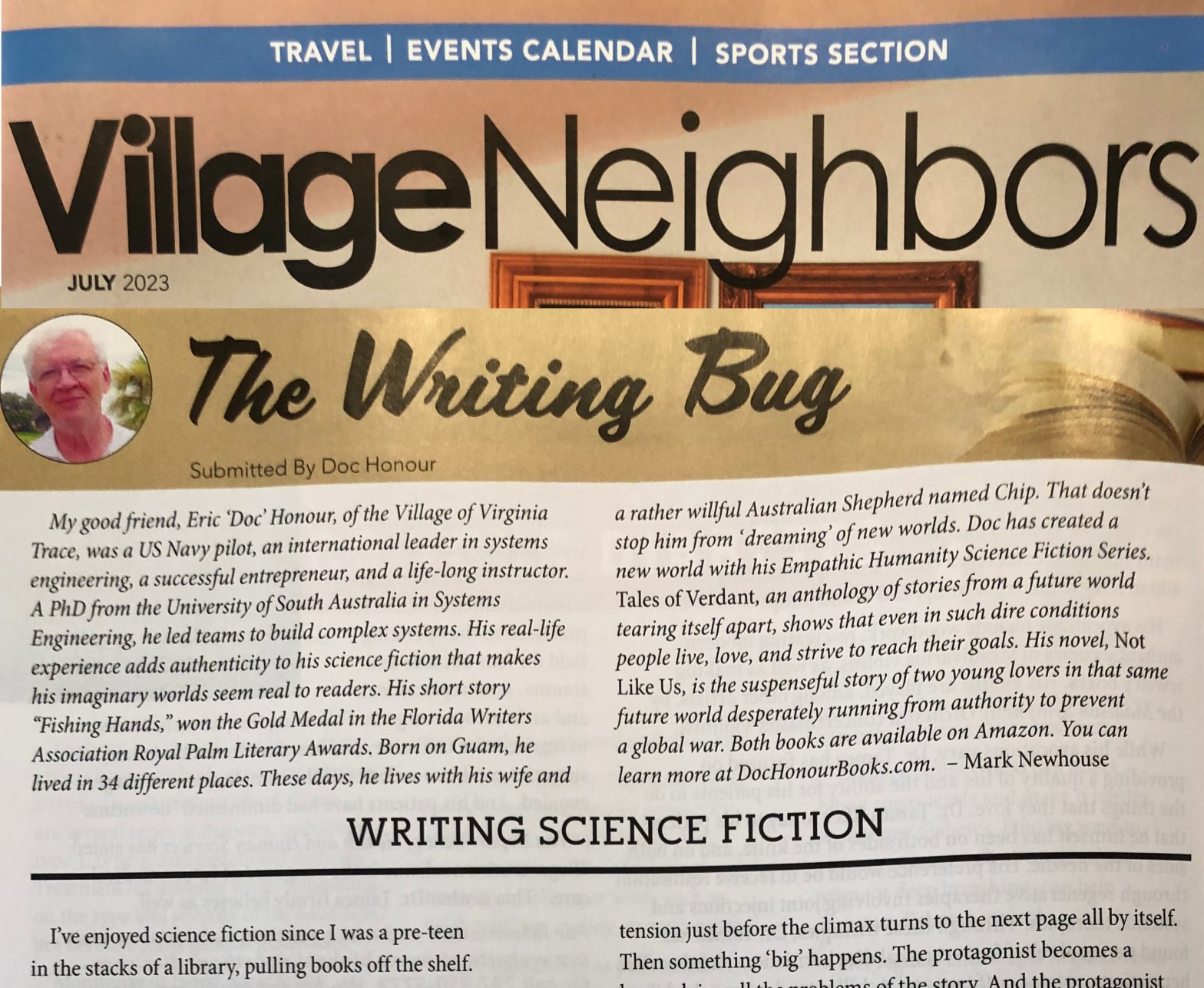
A recent publication!
Several months ago, my good friend Mark Newhouse asked if I would do a guest column for his article “The Writing Bug” in the local monthly magazine Village Neighbors. Mark is an accomplished author with multiple international awards, several for his acclaimed series The Devil’s Bookkeepers, based on true records from the Lodz Jewish ghetto in Nazi-controlled Poland. He also authors children’s books and has a series being converted to podcasts for this autumn.
I asked him what I should write about, and he said, “Write about your writing. What’s it like to write science fiction?” So here it is, now on the streets.
Doc Honour
June 2023
WRITING SCIENCE FICTION
BY GUEST COLUMNIST DOC HONOUR
My good friend, Eric ‘Doc’ Honour, of the Village of Virginia Trace, was a US Navy pilot, an international leader in systems engineering, a successful entrepreneur, and a life-long instructor. With a PhD from the University of South Australia in Systems Engineering, he led teams to build complex systems. His real-life experience adds authenticity to his science fiction that makes his imaginary worlds seem real. His short story “Fishing Hands,” won the Gold Medal in the Florida Writers Association Royal Palm Literary Awards. Born on Guam, he lived in 34 different places. These days, he lives with his wife and a rather willful Australian Shepherd named Chip. That doesn’t stop him from ‘dreaming’ of new worlds.
Doc has created a new world with his Empathic Humanity Science Fiction Series.Tales[EH1] of Verdant, an anthology of stories from a future world tearing itself apart, shows that even in such dire conditions, people live, love, and strive to reach their goals. His novel, Not Like Us, is the suspenseful story of two young lovers in that same future world desperately running from authority to prevent a global war. Both books areavailable on Amazon. You can learn more at DocHonourBooks.com.
WRITING SCIENCE FICTION
I’ve enjoyed science fiction since I was a pre-teen in the stacks of a library, pulling books off the shelf. A science fiction story is, first and foremost, a story. All the elements of a story must be present.
THE ELEMENTS
Opening: The story starts with something to grab the reader’s interest. The opening line of my novel, Not Like Us, is, “Hot aluminum flechettes pinged on stones inches over Jake’s head while he plastered himself prone behind the low wall.” The reader immediately wants to know what is this danger Jake is in—and what is a flechette anyway.
Characters: Every story is about people. In sci-fi, they might be aliens or computers, but they’re still people. Readers must want to know about the characters. They want to ‘feel’ from the characters’ viewpoints. They want to care about the people in the story.
Tension: For the story to matter, the characters must go into situations of danger, conflict, or emotional turmoil—the kinds of situations that change people. Readers want to feel the tension, get lost in the conflict, and see the characters change in response.
Plot: A good central plot drives the characters and increases the tension. A novel may have multiple plots and conflicts, each adding to the tension felt by the reader. The reader must be ‘involved in’ and exult in the battles, drawn from page to page to find out what happens next.
Climax: The plot elements and tension aim at a single point where everything resolves. Unbearable, nail-biting tension just before the climax turns to the next page all by itself. Then something ‘big’ happens. The protagonist becomes a hero solving all the problems of the story. And the protagonist changes as a result, coming out of the story a better person.
All of these—opening, characters, tension, pot, climax—are essential to any good story. In science fiction, however, one more element is necessary.
Worldbuilding:
While most fiction has the entire real world to work with, science fiction has the entire realm of the imagination, the past, and the future. The key question in sci-fi is “What If?” What if the galactic empire was falling apart and one man has a solution? (Foundation) What if the spaceflight that ties humanity together depends on a unique spice available only on one world? (Dune) What if dragons are necessary to save the world? (The Dragons of Pern) What if? frees the sci-fi author to create a new world with infinite possibilities.
So, in addition to creating all the elements of a good story, a science fiction writer must also create the world of the story. Writing sci-fi pushes description to the utmost, to convey to the reader a place no one has ever been and conflicts no one has ever seen. The sci-fi author must do this in such a way as to excite the reader’s imagination, making the new world ‘authentic’ without boring readers with ‘infodump’ and over-detailing. I find this creation of a new reality a challenge that is exciting. It is why I write science fiction.
Excerpt: Not Like Us
Jake saw Zofia ready for zero-G racquetball, wearing tight shorts, a halter top, and large-soled zero-G shoes. Man, oh man, but she looks good.
Jake loved this game with its feeling of freedom, like a bird in flight. He liked being able to use all six walls, shoving off in any direction. The computer-controlled beams counteracted gravity for every object in the court.
Today, though, Zofia’s lies had been too much for him.
“Hey, Jake. Are you okay?” She frowned at his attitude.
“Let’s just play.” His answer came out harsh even in his own ears.
She let it go and started the zero-G system.
As soon as he cleared the floor, he slammed a hard volley into the front corner.
“Wasn’t ready!” Zofia shouted as she barely returned it.
Jake didn’t answer, just slammed his second shot perfectly off an upper corner. “One,” he said. He didn’t look at her, and he served again, an ace she couldn’t even touch. “Two.”
He felt like he’d been overtaken by a zero-G racquetball demon with a direct channel to evil. He was fast. His positioning was superb, in the right place every time. As good as she was, Zofia was unable to keep up with him.
The demon burned higher. When she got in his way, he used his greater weight to bump her out. They’d both have bruises when this was over. The combat fed the anger he’d built.
He smashed her into a wall while positioning for a shot.
She shouted, “Ow! Take it easy.”
“Gotta play the game. Don’t get in the way,” he grunted and served again.
 Doc Honour Books